By Antonio Garcia Jan 07, 2026 6 min
If you are submitting paper information returns to the Internal Revenue Service for the 2026 tax filing season, Tax Form 1096 is the one document that actually legally connects those filings to you as the payer. This fillable form 1096 basically functions as a transmittal cover sheet, which allows the IRS to identify who filed the returns, how many returns were submitted, and what was the total amount that was reported. Although it is only one page, mistakes involving this form are a frequent source of rejected filings, processing delays, and penalties.
This guide explains exactly what the form is, who must file it, how it works, and how to complete it correctly for 2026, using IRS-verified rules and clear, plain-English explanations.
If you want to get your tax form filing sorted in a hassle-free manner, contact our experts +1-844-341-4437 now.
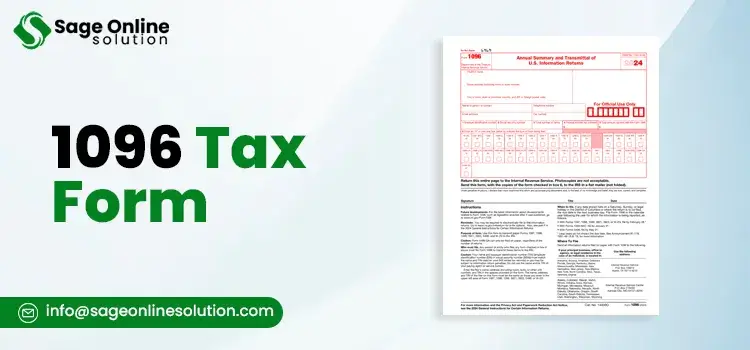
The official IRS name for form 1096 fillable is Annual Summary and Transmittal of U.S. Information Returns. It is not an income tax return and it does not replace Forms 1099, 5498, or similar documents. Instead, the 1096 form acts as a summary sheet that accompanies certain information returns when they are filed on paper.
Many filers first encounter this document while asking what is form 1096 or what is the 1096 form, because it only applies in specific situations. The IRS uses the data on this page to log incoming paper filings and confirm totals before the individual forms are scanned.
Important For 2026: While the form is simple, the IRS requires a wet-ink signature from an authorized officer or the business owner. A missing signature or an unofficial title is one of the leading causes of filing rejections.
The Paper-Only Mandate
One of the most important rules associated with IRS form 1096 is that it is never filed electronically. If you submit information returns through the IRS FIRE system or the newer IRIS platform, you do not file a transmittal. The IRS automatically generates an electronic summary.
This means form 1096 IRS requirements apply only when physical paper forms are mailed. Understanding this distinction is essential when learning what is a 1096 form used for.
In fact, if you are searching for how do i file form 1096 electronically, the simple answer is that the IRS doesn’t actually allow it. Since the form serves only as a physical transmittal for paper, your question that “can i file form 1096 electronically?” is incorrect. The digital systems (FIRE and IRIS) generate their own summaries, effectively answering the question of how do i file form 1096 electronically by removing the need for the form entirely.
The 2026 E-File Threshold
For the 2026 filing year, the IRS enforces an aggregate e-file threshold of 10 or more information returns. This total includes all types combined, such as W-2s and 1099s. Once this threshold is met, electronic filing becomes mandatory.
As a result, what is form 1096 used for now applies almost exclusively to small or occasional filers who submit fewer than ten paper forms. In practice, this makes 1096 IRS form filings increasingly rare, but still fully enforceable.
Not every business owner will need to touch this form. Since the IRS has moved aggressively toward digital filing, the “Who” has become much more specific for 2026. Understanding what is a 1096 form used for starts with knowing if you even qualify as a paper filer.
You are required to submit an IRS 1096 form if:
If you e-file, you skip this entirely. If you use the IRS IRIS portal or tax software to submit your 1099s digitally, you do not need to mail a paper 1096 transmittal form.
You can actually think of tax form 1096 as an umbrella that will basically cover a specific section of the IRS documents. While most people use it for 1099s, it actually transmits a wide variety of “Information Returns”.
If you are in a search for a 1096 fillable form to print out, you need to remember that you have to utilise a separate transmittal form for each of the following specific sections:
Even though one federal form 1096 can summarize all these types, it cannot summarize them together in one stack. For example, if you have three 1099-NECs and two 1099-MISCs, you must mail two separate envelopes, each with its own 1096 tax form on top.
The physical construction of Tax Form 1096 is not optional or cosmetic. It is there to meet the IRS’s scanning requirements.
OCR Compatibility Explained
When it comes to paper filings, the IRS basically relies on Optical Character Recognition technology to process them. Most scanners are pre-calibrated to read certain layouts and ink colours. The red ink is used only on official forms, which is engineered to “drop out” during a scan but allowing black data to appear.
This is why the 1096 tax form must be an official version and not a standard printout.
The “No-Download” Warning
Although the IRS makes a form 1096 pdf available for viewing, printing that document and mailing it is not allowed. Downloaded copies do not contain the required red ink and will not scan properly. The same rule applies to any 1096 form pdf printed from a website.
Mailing an unofficial copy can result in the IRS treating the filing as missing, even if the information is correct.
The “Courier Font” Preference
The IRS scanners are optimized for 12-point Courier font. While not strictly mandatory (handwriting is allowed), using a typewriter or computer printer with Courier font significantly reduces the chance of a “No Match” error.
Handwriting Constraints
If you want to fill form 1096 pdf by hand, you must use black ink, never blue, red, or pencil, and must stay within the boxes. Block letters are preferred.
The “No Staples/Paperclips” Rule
This is a physical requirement that often gets missed. Staples can jam the high-speed scanners or tear the “Copy A” red forms.
Filers often ask where can I get a 1096 form that meets IRS standards for 2026. If you are looking for where to find form 1096 or specifically where can I get form 1096 that is officially scannable, there are three approved options. However, you must be careful, as if you ask “can I download a 1096 form?” the answer is yes, but only for your internal records. You cannot print a 1096 form online on standard white paper and mail it to the IRS. They use high-speed scanners that require the original red-ink version; using a home-printed copy can result in a penalty.
If you are wondering how to get a 1096 form, or are in a continuous worry of how do I get a 1096 form, or how to get 1096 form copies that won’t get rejected, use these methods:
Whether you are looking for where to get a 1096 form or where can I get a 1096 tax form, ensuring it is the official “Copy A” version is critical for how to file 1096 form compliance.
Getting your tax form 1096 right is about more than just filling in the blanks, it’s about organization. Grouping errors are easily the most common reason the 1096 form IRS scanners reject a submission. Think of the 1096 transmittal form as a “header” that tells the IRS computer exactly what kind of documents are following it in the stack. If you mix them up, the system gets confused.
The Single-Type Rule
The most important thing to remember about what is 1096 form logic is the “Single-Type Rule”. You cannot bundle different types of 1099s under one transmittal. Each category needs its own dedicated cover sheet.
Look below at some real scenarios that’ll help you understand better:
Handling “Void” vs “Corrected” Forms
If you’re wondering what is 1096 form protocol for mistakes, pay close attention to the boxes at the top of your 1099s:
The Physical Assembly (The Mailing Rule)
The IRS uses high-speed intake machines, so the way you physically stack your 1096 form IRS submission matters:
If you’re wondering how to file form 1096, filling out your federal form 1096 isn’t necessarily hard, but it is extremely precise. Knowing how to fill out a 1096 form properly is the first step to avoiding IRS letters. Whether you are looking for how to fill out 1096 form basics or how to complete 1096 form totals for a complex batch, the process is the same. Many first-timers ask “how do you fill out a 1096 form?” The key is to remember it is a summary.
Below is exactly how to fill out form 1096 without making the common mistakes that lead to IRS letters.
Filer Information And TIN Entry
First, ensure that your name and address are exactly as you indicated on your attached 1099s. After that, you need to turn your attention to the Taxpayer Identification Number (TIN) part of the form:
Box 3: The “Count” Box
On form 1096 box 3, you need to enter the total number of individual forms you are attaching.
Box 4: Federal Income Tax Withheld
This is the total amount of backup withholding you took out of the payments. If you didn’t withhold any taxes, which is common for many small businesses, simply enter “0”.
Box 5: Total Amount Reported
This is the part that causes the most stress when people are figuring out how to fill out form 1096. You aren’t just adding up every number on your 1099s, you are only adding specific boxes.
Below is the breakdown of what to sum up for some of the most common forms:
Box 6: Selecting The Form Type
In this section, you’ll see a row of checkboxes. You must mark only one box. This tells the scanner exactly what is a form 1096 acting as a cover for in this specific batch.
MISC vs NEC Confusion: A common point of confusion is how to handle a 1096 form 1099 MISC with NEC in box 7. Even though non-employee compensation used to be on the MISC form years ago, it now has its own home on the 1099-NEC. If you are filing both types, you must separate them into two stacks, each with its own 1096 transmittal. You cannot check two boxes on a single 1096.
Once you have mastered how to file 1096 form data, the final hurdle is determining where to file form 1096. Because the IRS uses automated scannable equipment, they divide the country into regions. If you are asking “where do I mail form 1096,” the answer depends entirely on your principal business location.
Rather than searching for a single catch-all address, you should know that there are three primary Submission Processing Centers, Austin, TX, Kansas City, MO, and Ogden, UT. To ensure you know exactly where to mail 1096 form packets for your specific state, you should always reference the “Where to File” chart on the second page of the official IRS instructions.
Checking where to mail form 1096 is vital, as sending it to the wrong center can lead to significant processing delays or lost documents.
Knowing how to file a 1096 tax form properly means getting the math right on the form and verifying the current regional center link on IRS.gov before you head to the post office.
Knowing exactly when is form 1096 due is the only way to keep the IRS from knocking on your door with late filing penalties. Many filers search for when are form 1096 due or when is IRS form 1096 due only to find that it isn’t a “one size fits all” deadline; it actually depends on which specific forms you are attaching to the transmittal.
Key 2026 Deadlines: Mark these dates on your calendar. If you miss the specific form 1096 due date for your batch, the IRS can charge you per individual form in the stack.
Postmark vs. Receipt: The IRS considers your filing “on time” as long as the envelope is postmarked by the relevant form 1096 due date. You don’t have to worry if the mail takes a few extra days to reach their processing center, as long as the stamp shows you met the deadline.
Even with the best preparation, mistakes happen. Whether it’s a typo in a contractor’s name or a math error in your totals, knowing how to handle an IRS 1096 form correction is vital for staying in the clear.
How To Fix A Mistake?
If you realize you’ve sent in a form with the wrong information, don’t panic. You can fix it by filing a “Corrected” return.
The Cost Of Waiting: 2026 Penalties
The IRS has increased its penalty rates for the 2026 filing season. These fines are “per form,” meaning if you have a stack of 5 forms that are late, you pay the fine five times.
| Timing Of Correction | Penalty Per Form (2026) |
| Within 30 days of the deadline | $60 |
| After 30 days but by August 1 | $130 |
| After August 1 (or not filed at all) | $340 |
| Intentional Disregard | $680+ |
If you are filing a 1096 a form transmittal for something like 1099-A (Acquisition or Abandonment of Secured Property), these same penalty tiers apply.
Common Errors To Avoid
Before you head to the post office, do a final scan for these “silent killers” that trigger IRS 1096 form rejections:
Wrapping up your Tax Form 1096 filing doesn’t have to be a source of stress. As much as the shift toward digital filing has made paper transmittals less common, staying compliant with the remaining 2026 physical requirements is a legal necessity for small filers. By utilizing the red ink documents and meeting the specific deadlines for your type of documents, you are able to ensure your filing goes through the IRS scanners seamlessly. Keep in mind that your best defense against delays of processing is a clean, unclipped, and signed transmittal.
Want to get your tax form filing done without the headaches? Connect with our experts +1-844-341-4437 now.
Read Here:
Sage Tax Forms Filing Services
Frequently Asked Questions
The form 1096 instructions demonstrate the process of completing the transmittal properly to mail paper information returns to the IRS. They provide details on where to enter the payor information, calculating the totals of the attached forms, as well as the boxes to check.
A 1096 tax form is a type of form that is used as a cover or a transmittal when you’re mailing paper information returns, such as 1099 forms, to the IRS. It summarizes how many forms you’re submitting and the total amounts reported. You will only need this form if you’re filing on paper and fall below the IRS e-file threshold category.
No, there is no difference between federal form 1096 and Form 1096. They both refer to the IRS transmittal form that is used for paper filings of information returns. It’s a federal requirement and applies only when returns are mailed, not electronically submitted.
When you’re dealing with a 1096 form 1099 MISC with NEC in box 7, it is very important to check that you do not mix different 1099 types under one transmittal. Each of the categories must be sent with their own individual Form 1096. Keeping them separately makes sure that the IRS processes your filing without any confusions or delays.
Form 1096 Box 3 is basically a section where you list the total number of information returns that are included in that mailing. This number must exactly match with the forms that are attached underneath the form 1096. Even with the smallest of mismatch, it can trigger an IRS review or may cause processing issues.
If you’re looking for how to file form 1096, the key to this is accuracy and organization. Complete the form, place it on top of the matching returns, and mail only the red Copy A forms to the IRS. You need to remember that Form 1096 cannot be e-filed and it must always be sent with the paper returns.
The form 1096 due date actually depends on which information returns are being submitted. For 1099-NEC forms, it’s basically in the early February, while for most of the other 1099 forms it is due in early March. One thing you need to remember is that as long as your envelope is postmarked before the deadline, the IRS will considered it filed on time.

Mar 24, 2026
Mar 23, 2026
Mar 19, 2026
Mar 13, 2026
Mar 13, 2026
© Copyright 2026 Sage Online Solution | All Rights Reserved
US
UK