By Antonio Garcia May 14, 2024 16 min
Data corruption inside Sage can stop payroll, invoicing, and reporting in seconds. If you’ve ever got an error “Sage 50 is unable to read database file & failed to restore database”, you know how serious it can get. The built-in Sage 50 Database Repair Utility is designed to resolve structural file damage, rebuild indexes, and support proper data corruption repair before data loss becomes permanent. Understanding how it works is critical for protecting financial records.
Facing database instability? Get immediate assistance by speaking directly to our certified Sage 50 Database Repair Utility experts at +1-844-341-4437.
Sage 50 Database Repair Utility is a maintenance tool that is built in and included with Sage 50 (U.S. edition) that diagnoses and then repairs structural damage within a certain company file. It is part of the broader Sage database repair utility framework that is used to correct file inconsistencies, rebuild indexes, and validate database integrity.
Sage 50 operates on the Actian, (earlier Pervasive) database engine. Company data is stored primarily in:
When corruption occurs within these structures, Sage 50 database repair processes become necessary to restore accessibility and prevent reporting inaccuracies.
What Is That The Utility Actually Does?
Sage 50 Database Repair Utility performs:
It primarily includes two maintenance functions inside Sage:
For more serious damage, deeper Sage 50 database repair measures may be required, including company file restoration or manual reconstruction.
If you’re unsure whether your issue requires basic repair or advanced recovery, connect with our Sage specialist for secure Sage data repair guidance at +1-844-341-4437.
A construction services firm reached out after receiving a “Job Cost and Total Balance Mismatch” error while trying to update customer invoices in Sage 50. The invoice would save but failed to post, creating reporting inconsistencies in Accounts Receivable and project costing. The issue pointed to transactional data imbalance within the job cost module.
Solution Provided
Our Sage experts followed verified correction procedures supported by official guidelines:
After correction, the invoice updated successfully, and job cost reports aligned with the general ledger totals.
If you also are facing the same Sage 50 invoice update errors or job cost balance mismatches, our team +1-844-341-4437 delivers structured, compliance safe Sage 50 data repair solutions backed by official recovery tools and proven accounting workflows.
A small business owner contacted us after repeated Sage 50 update failures following a retail purchase from Staples. The software would not complete the latest product update, and the customer decided to request a refund. They needed clear and to the point guidance on both resolving Sage 50 update error and understanding the proper refund channel.
Solution Provided
Our certified consultants followed official procedures that were aligned with Sage Group plc policies:
Since the software was purchased through Staples, our advice to the client was that refunds must be processed through the retailer according to Staples’ return policy, and not Sage directly. We guided them on initiating the return within the eligible window with the proof of purchase that was made by them.
The client successfully submitted the refund request and avoided further licensing complications.
If you require any assistance with Sage 50 update errors or retail purchase concerns, our experts provide verified support that protects your investment, so you can get in touch with them right away +1-844-341-4437.
A manufacturing company contacted our team after receiving the error: “Sage 50 is unable to read the database file and failed to restore the database”. Backups were continuously failing, and the company file had grown significantly in terms of size. The issue pointed to data file corruption combined with an oversized database affecting performance and restore functionality.
Solution Provided
Our certified Sage experts resolved their issue by following officially supported recovery procedures:
The database integrity was restored, file size was optimized, and scheduled backups resumed without errors.
If your Sage 50 backup fails due to data corruption or large database size, get in touch with our experts +1-844-341-4437, and get a structured, compliance-safe recovery delivered to protect your financial data and restore system stability quickly.
A service providing firm contacted our team after identifying a discrepancy between the Balance Sheet and the Accounts Receivable Aging report in Sage 50. The receivables total on the Balance Sheet did not match the customer aging summary, raising concerns about reporting accuracy before quarterly filing.
Solution Provided
The solution that our experts came out with to help the customer get rid of this issue was as follows:
After structured correction, the Balance Sheet receivables matched the detailed aging report, restoring financial statement accuracy.
If your Sage 50 balance sheet does not match Accounts Receivable totals, contact our experts +1-844-341-4437, and allow us to provide a compliance focused reconciliation and data integrity repair to ensure your financial reports remain accurate, and audit ready.
Data corruption in Sage 50 rarely happens without a trigger. Understanding the root cause helps prevent repeated failures and reduces the need for emergency Sage data corruption repair.
Below are the most verified causes based on Sage technical documentation and real-world repair cases:
If you’re noticing recurring database instability, don’t wait for complete failure and data loss. Get professional assistance to get resolution for this trouble before damage spreads. Call our Sage data repair experts.
Database corruption rarely appears without warning. In most cases, Sage 50 shows clear symptoms before complete failure. Recognizing these indicators as early as possible can actually prevent any deeper structural damage and also reduce the downtime that’ll require major Sage 50 database repair.
Below are the most common warning signs that one should look for:
If you’re experiencing any of these signs, immediate action for Sage 50 database repair is critical. Delayed repair increases the risk of permanent data loss.
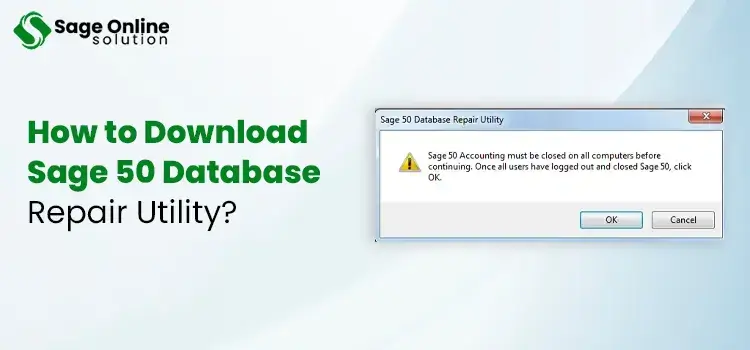
Many users search online to download Sage 50 database repair utility, assuming it is a separate standalone tool. In the most latest Sage 50 versions, the repair functionality is directly built into the program installation and it doesn’t require any sort of separate download.
Is It Stand-Alone Or Is It Built-In?
Sage database repair utility is usually installed automatically with Sage 50. It can be accessed through:
If the utility is missing or is damaged, the recommended approach is not downloading from third-party websites. Instead, use one of these official methods:
Official Repair Or Reinstall Method
Always make sure that your:
Important Note: Never make an attempt to download Sage 50 database repair utility from unofficial websites. As, modified installers can damage company files or introduce malware, making future recovery more difficult.
If you’re unsure about the correct installation source or version match, get professional guidance for secure access by speaking with our certified Sage database repair utility technicians at +1-844-341-4437.
When corruption is suspected, using Sage 50 database repair utility correctly becomes extremely critical. Running it improperly or skipping preparation steps can worsen file damage. Below is the officially recommended process based on maintenance procedures.
Step 1: Firstly, Create A Full Backup
Step 2: Close Sage Completely
Second step is to always make sure that below mentioned pointers are on point followed, as multi-user access during repair can cause further corruption:
Step 3: Run As Administrator Setting
Step 4: Select the Company File
Step 5: Choose The Appropriate Option
• Check Data – Scans for structural errors and inconsistencies.
• Rebuild Data – Repairs damaged indexes and relational issues.
Step 6: Review The Log File
• Error codes
• Table repair confirmations
• Unresolved warnings
Step 7: Restart Sage And Verify
File → Maintenance → Check Data Integrity
Essentially, The Time Required For This Can Depend On Your Total File Size, For Example:
There Are Three Things That You Need To Make Sure That You Do Not Do:
If repeated attempts fail or logs show persistent structural damage, deeper intervention is needed, but you do not need to worry about it, as you can get in touch with our experts +1-844-341-4437 if you are not comfortable using the Sage 50 database repair utility on a live company file.
One of the most alarming situations for any accounting team is when backups got failed due to Data file damaged/corrupted errors. In most cases, this happens because the backup process in Sage 50 relies entirely on the integrity of the underlying database engine. If the .SAI or .SAJ structure is already compromised, the system cannot create a stable compressed backup.
Why Backup Fails When The Data Is Corrupt?
Backups are just not some simple file copies. Sage validates the entire database structure before compressing, which includes:
If the engine detects broken links or damaged tables, the backup process stops immediately. That is why many users first discover corruption only after seeing:
How To Recover Safely?
If your backup fails, follow this controlled recovery sequence:
If there comes a situation where no clean backup exists:
In more severe cases, structured Sage 50 data repair at database level may be required before any backup can be created successfully.
If your backups got failed due to Data file damaged/corrupted, connect with our expert recovery team at +1-844-341-4437 immediately.
When the standard tools fail to resolve errors, advanced level Sage data repair becomes necessary. While the built-in repair functions in Sage 50 handle most of the minor corruption cases, severe database damage requires deeper structural intervention.
This typically occurs when:
At this stage, standard Sage 50 database repair processes may not be enough.
What To Do When The Built-In Utility Fails?
If Check Data and Rebuild Data both fail:
In such cases, deeper Sage data repair methods include:
These procedures require technical understanding of the database architecture and should not be attempted on a live production file without experience.
Creating A New Company And Importing Data
A controlled recovery method involves:
This method preserves usable data while isolating corruption.
SQL-Level Repair
Because Sage 50 relies on the Actian/Pervasive SQL database engine, severe corruption may require:
These steps are considered advanced and must be handled carefully to prevent permanent data loss, so get in touch with our Sage 50 database repair experts +1-844-341-4437.
It’s important not to confuse the process with Sage 100 data repair, which operates differently. Sage 100 uses a separate SQL-based framework and repair utilities specific to its ERP architecture.
Key differences include:
For complex Sage 100 data repair or deep level Sage 50 database recovery, feel free to reach out to our Sage experts +1-844-341-4437.
Preventing corruption is much more effective option than fixing corrupted files again and again. Although the Sage 50 platform has Sage 50 Database Repair Utility tool, but still having maintained the stability requires careful system management and discipline.
Below are 8 of the simplest and most practical steps to reduce the need for frequent use of Sage data corruption repair:
Sage 50 Database Repair Utility should be treated as a corrective safeguard, not a routine maintenance tool. With these preventive practices in place, businesses significantly reduce corruption risks and maintain a stable accounting environment.
Sage 50 Database Repair Utility is an important tool for restoring company file integrity when corruption happens. However, it’s only one part of a larger data protection strategy, proactive maintenance, verified backups, and expert support are equally important. Whether you are dealing with some minor indexing problems or are faced with serious corruption, being able to make informed decisions on the fly can be the difference between saving time and money or losing it.
For the best help with Sage 50 database repair from qualified professionals, contact +1-844-341-4437 today and safeguard your business data before it’s too late.
Read Here:
Sage 50 Error Connecting To Database
Frequently Asked Questions
Sage 50 Database Repair Utility helps in the identification and correction of the database structural inconsistencies and corruption that are responsible for preventing the company file from opening or functioning normally. It then checks data integrity, rebuilds indexes, and attempts to fix corrupted tables before more advanced repair tools come into action.
No, it is not, as you have to make sure that all users are logged out of the system and that there is a recent backup of the system even before you think of running the utility tool. As, working on a live or multi-user file can create more problems and cause unrepairable damage to your files.
Time taken to repair the file depends on the size of the file, the level of corruption, and the system’s processing capabilities. Smaller files with less severe corruption can be repaired in a matter of minutes, while larger files with more severe corruption could take hours or even the need for advanced repair techniques.
Yes, in some cases, depending on the level of corruption, which might be less severe to the extent that the database engine can rebuild the indexes or structural paths. Nonetheless, backups are still the best point to revert to.
The difference is in their database model, Sage 50 actually utilizes a file based Actian database, whereas Sage 100 is based on a client server SQL database structure. Both are repaired using different utilities and techniques. While Sage 100 data repairs may use direct SQL recovery methods, Sage 50 repairs use native tools and data exports.
This is essentially saying that the company file integrity checks have failed because of discrepancies in table relationships, journal balances, or indexes. The Data Integrity or Company File Check & Repair utility may resolve these issues, but sometimes more advanced repairs are required for continued problems.
It is always important to make a full backup of your company file immediately before running any repair utility. Making daily backups, especially before running any repair utility, will ensure that you do not accidentally lose your data and will also provide a means of recovery in case the repair utility does not work.

Mar 13, 2026
Mar 13, 2026
Mar 10, 2026
Mar 10, 2026
Mar 10, 2026
© Copyright 2026 Sage Online Solution | All Rights Reserved
US
UK