By Antonio Garcia Jan 18, 2024 6 min
The Sage 300 is an excellent fit for any business enterprise, offering various solutions through which they can easily automatize their working processes. On the basis of the basic working structure of any business enterprise, the Sage 300 offers various suites with financial, operational, payroll, and other core options. While the major need of any business software is to manage its finances, the crucial component that any business application should have is the General Ledger Integration and Tax management options. While both of these are must-have components, a major function is how you can use these together.
Here, we will tell you how you can integrate Tax services with General Ledger for Taxes and other related information. Along with that, we will list some of the best features of the Sage 300 which users can easily utilize to automate their daily operations. Stick to this narrative till the end to get more details on the Sage 300 application and General Ledger Integration with Tax Services.
+1-844-341-4437
By definition or in general terms, a general ledger is simply a database or repository that keeps the data of all the financial transactions made in a company. In the General Ledger, a company can track all the financial records or transactions like sales, purchases, payments, and other receipts related to various transactions made by the company. Some of the basic features of the General Ledger involve account process automation, financial & transactional reporting, and the management of the chart of accounts. While these are basic features that need to be mandatorily present in any business software, General Ledger also offers some additional features that can be essential for any business enterprise to handle their processes. These include:

The first thing to know before getting information about General Ledger Integration in Sage 300 is to how you can setup General Ledger in Sage 300. Users need to set up General Ledger in their Sage 300 applications through which they can easily determine how G/L can interact with various modules of the Sage 300. Along with that, through General Ledger setup, users can easily set up accounts, different options, and security authorization related to it in their Sage 300. You can also contact our expert on Sage Accounting Phone Number, who are available to help our users at any point of time.
Setting up a General Ledger Accounting Services is a Simple and Stepwise Process Discussed Below:
The first step is to set up various database tables required by the General Ledger application. For this, navigate to the Administrative Service Folder and then Hit the Data Activation icon on the screen. Activation of the General Ledger will require the information related to the current Fiscal Year and the starting date of the oldest fiscal year data, which you need to keep in your General Ledger Account.
Afterward, you need to select various options you need to include in your General Ledger account. These can be sample charts of accounts, account groups, what account segments can be used and how many, whether or not print batches or allow posting to the previous years. Therefore, to configure your General Ledger Account and select various options, you need to utilize the following G/L screens:
Lastly in order to install General Ledger in Sage 300, you need to add various accounts. Afterward, you have to enter the year-to-date balances of each of your General Ledger Accounts.
The next major thing to discuss under General Ledger Integration is the Tax Services. Through the Tax services amenity in the Sage 300, users can easily manage taxes laid due to the sales and purchases made by the company. It is easy for users to report tax information through tax services. To utilize this option, you need to set up Tax Service in your Sage 300. Activating tax services can be necessary for the user as various accounting programs sometimes require sales tax data.
Once after activation, the Tax Services icon gets add to the common service folder.
Follow the steps below in order to add Tax Authorities and Tax classes in Sage 300:
To delete the Tax authorities, you need to follow the given path:
Different tax classes that can be added to a Tax Authority include Sales Items, Customers, Vendors, Purchase Items, and many others. Before adding Tax Classes, it is mandatory that you add Tax Authority. Afterwards, you can follow the given steps:
Tax Classes can be added and deleted easily by the user through the option “Common Services” followed by “Tax Services” and then “Tax Class.” Select the Tax Class you wish to delete. With all the details being discussed, you can now easily add Tax Services to your Sage 300 Applications.
+44-800-810-1881

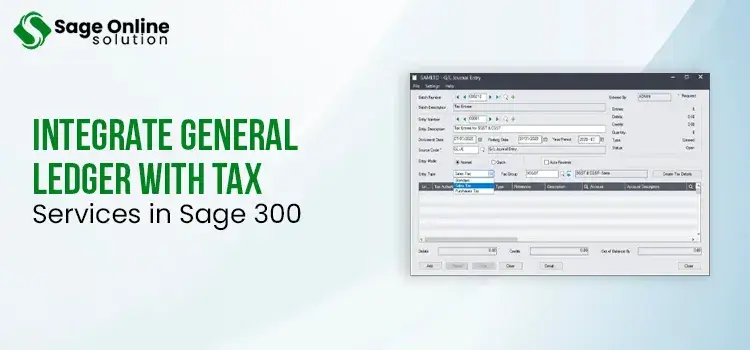
The Sage 300 Cloud offers its users the ability to integrate tax services, through which users can easily enter tax amounts in general ledger journal entries. Once you have set the General Ledger Accounting services and the Tax Amount for various sales and purchases, you can easily add them to Journal Entries while creating them. Users also have the option to add tax amounts in the Journal Entry while creating them, or they can add them later. However, you need to set up tax amounts relating to the sales or purchases. This will include adding Tax Authorities and other Tax services all of which have been discussed in the section above.
While Adding the Journal Entry, you can easily add the Tax amount. However, you can also add tax amounts later. Follow the steps below to know more about General Ledger Integration with Tax Services in Sage 300:
Whatever amount you have entered in the General Ledger account will be automatically displayed in the Tax Account Details.
The Sage 300 is an excellent option for large-scale business to manage their finances and other operation-related tasks. Major components for any business that can easily Automates General Ledger and Tax Services. Moreover, Sage 300 offers the option through which you can easily add Tax Amount details in any General Ledger Journal Entry. While it can be easy and simple to add a Journal and include other tax amount details, you can connect with Sage Online for any assistance regarding any issue you are facing with Sage 300, Sage 50 or any other version of Sage.
+1-844-341-4437
What is General Ledger in Sage 300?
The General Ledger in Sage 300 can be considered as a database, repository, or single platform where users can find all the financial transactions made by the company. Any kind of accounting information related to the business can be tracked or found in the General Ledger.
How Can I Export General Ledger in Sage 300?
You can easily share the General Ledger or extract it from the Sage 300 through the amenity of print. In the General Ledger Details, you can easily find the Print Setup button and select the file you want to fetch. Along with the Print option, you can also find the “Save as Type” option, after which you need to select the location in your system to save it.
How Can I run or view a General Ledger report in Sage 300?
In Sage 300, open reports and then hit on the General Ledger report. Select the time period for which you need to view the General Ledger Reports. Provide other details like type and category. To view the report, you can either save it through Export Summary or Export Detailed. Select the format in which you want to save it (CSV or PDF).
What are Tax Services in Sage 300?
Through the option of Tax Services, users can easily manage their Tax-related details in Sage 300, referring to various sales and purchases made by them.
How Can I Add Tax Related Details in Sage 300?
Users can add Tax Authorities and Tax Classes under which they can mention various amounts that are Tax-Related.
How to Add Tax Authorities and Tax Classes in Sage 300?
In Sage 300, go to common services, then Tax Services, and then Tax Authorities, after which you need to add 12 12-digit alphanumeric codes. Once you can add Tax Authorities, you can add Tax classes under them.
What is General Ledger Integration and what it is used for?
Through General Ledger Integration, users can transfer different accounting components to the corresponding accounts. With the help of G/L integration it is easy to update various accounting details like interest, charge income, expenses and other different items.
How to Add a Journal Entry in Sage 300?
Users can easily create a Journal Entry in their Sage 300 application. Under the General Ledger section, you can find the option G/L transaction, under which there will be the option “Journal Entry.” Click on Add Journal Entry and provide the relevant details, after which your journal entry can be created.
How to Add Tax Amount in Journal Entry?
Users can add Tax Amounts either while creating a journal entry or they can add afterward under Tax Group and then “Create Tax Details.”
What are some General Ledger Common Errors with solutions?
Common Errors related to General Ledger are simple entry mistakes made during the entry process. The common solution for that is to directly fetch the data from the source in an accounting application like Sage 300.

Mar 13, 2026
Mar 13, 2026
Mar 10, 2026
Mar 10, 2026
Mar 10, 2026
© Copyright 2026 Sage Online Solution | All Rights Reserved
US
UK