
By Antonio Garcia Feb 13, 2026 13 min
April is around the corner, and for every entrepreneur, the schedule is quite hectic. Well, the 2025-26 tax year isn’t just a sequence of numbers on a spreadsheet, but a highly risky set of thresholds, deadlines, and changing compliance standards. Without Sage tax calendar 25/26, you’re just roaming through a digital mess of receipts and what-ifs. Don’t you? But what if you could navigate the next twelve months precisely? For this, get your hands on the tax calendar, which can help you plan accordingly and achieve financial peace of mind.
The calendar has filtered the complex net of HMRC and IRS milestones into a streamlined, slang-free platform. You won’t have to undergo more complex calculations or lose in the mail excuses from the authorities. This tax calendar will help you start the tax season off right with Sage automated foresight.
If you’re searching for a complete Sage payroll tax calendar 2025/26 breakdown, having the official schedule in place helps prevent missed submissions and unnecessary HMRC penalties.
Need further information on Sage tax calendar 25/26? Feel free to connect with our experts at +1-844-341-4437 and have a one-on-one conversation with our Sage experts!
Specifically developed for business entrepreneurs like you, Sage payroll tax calendar 2025/26 is built with functionality that holds a system-defined schedule of financial periods, tax months, and tax weeks. It majorly helps you accurately and timely manage your payroll submissions, tax compliance, and reporting.
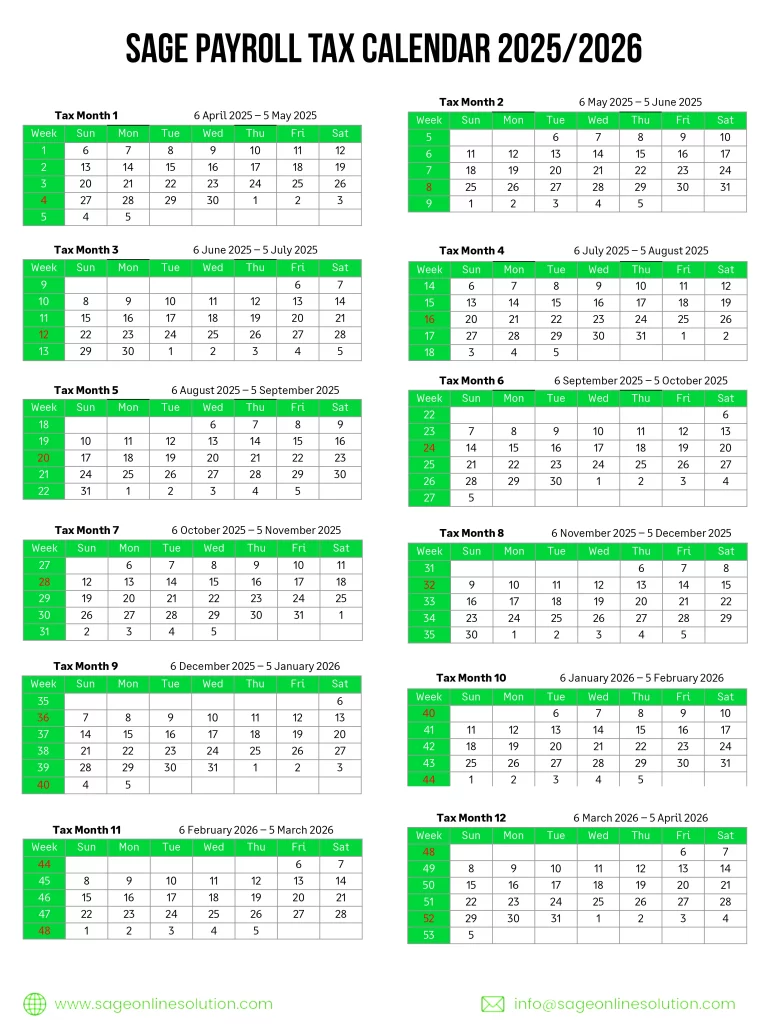
For companies across the UK and the U.S., Sage Payroll Tax Calendar is a critical schedule of tax deadlines and software-specific tasks. Users with Sage accounting and payroll software must go through the calendar to mark all the key dates. These are starting from April 6, 2025, to April 5, 2026, in the UK, and January 1 to December 31 in the U.S.
Beyond just a list of dates, it’s a roadmap for Sage users to stay updated with the compliance standards and be aware of when to update the software, file a tax return, and submit forms to HMRC.
Sage tax calendar also aligns directly with HMRC’s Real Time Information (RTI) framework, ensuring FPS and EPS submissions follow the correct pay reference periods throughout the 2025/26 tax year.
Have a look at the following aspects of Sage payroll tax calendar 2025/26 for a better understanding:
1. Tax Weeks And Tax Months
The calendar keeps tracking the weeks and monthly cycles as per the tax months running from the 6th to the 5th date of the following month.
2. Payroll Dates Alignment
This is to set up the Pay Reference Periods (PRP) for weekly, bi-weekly, and monthly. The calendar aligns payment dates with the required tax submission dates in real-time. The entire financial data and its tracking are cloud-based.
3. Financial Reporting Period
Sage 300 users are allowed to lock/unlock specific periods to manage their account closing through the fiscal calendar.
4. Tax Year-End
Particularly within payroll, the Tax year-end function in the calendar defines the start and end of the tax year, which is from April 6 to April 5 in the UK, and January 1 to December 31 in the U.S. This tracking allows accurate reconciliation of financial data, which is crucial while generating the final tax return.
The payroll year is about to end. For paying via post, April 19 is the final submission date, while April 22 is the date for digital payment. Before finalizing your accounts and closing the books, you need to consider Sage payroll’s new tax year checklist 2026.
Sage payroll new tax year checklist is essential to ensure a smooth rollover from 2025/26 into 2026/27 without payroll errors or rejected submissions.
Below are the year-end things to do:
◦ Weekly payroll on April 5, which is the 53rd week of the payroll.
◦ Two-weekly payroll, which falls on April 5. It’s the 54th payroll week.
◦ Four-weekly payroll on April 5, which falls between April 5 and May 2 in the 56th payroll week.
Following Sage payroll new tax year checklist also ensures your employee records, NI categories, and student loan plans are correctly carried forward into the new year.
To ensure you’re ready to step into the new tax year, you must perform the tasks below as per Sage Payroll New Tax Year Checklist 2026:
1. Check Your Software Version
Before you proceed with the new tax year, check your software version. For this:
2. Update The Tax Codes
For Sage 50 payroll year end 2026, the emergency tax code and personal allowance are the same, which is at £12,570 and 1257L.
It indicates that you don’t have to update any employee tax codes unless directed by the HMRC. However, you need to clear the week1 or month1 flags.
3. Claim For Employment Allowance
Make sure you apply to claim the employment allowance at the beginning of every tax year. For this:
4. Apply To Claim SER (Small Employers’ Relief)
Typically, a company qualifies for SER if it is liable for National Insurance contributions of £45,000 or less in the last complete tax year. Follow the prompts for more:
Key Legislative Updates
Never overlook the legislative changes; they matter! Sage Payroll New Tax Year Checklist 2026 also indicates the following compliance updates for the new 2025-26:
These updates are automatically reflected once you install the latest 2025/26 Sage payroll update included in the Sage tax calendar 25/26 release pack.
Sage Software Updates
To stay compliant during Sage tax calendar 25/26, users need to perform specific Sage software updates. Here’s what action to take:
Keeping your Sage payroll tax calendar 2025/26 fully updated ensures these compliance changes are reflected before your first payroll of the new tax year.
For any individual running a business and who is looking forward to proceeding with the new tax year, the following dates are non-negotiable:
The Wrap-Up Phase Of 2024-25 From April To July 2025
Before stepping into the 2025/26 year, you need to close the previous one. The specific Sage Tax Calendar dates are:
The 2025-26 Cycle From August 2025 To January 2026
The Phase Of 2025/26 Year-End In April 2026
Monthly and quarterly Sage tax calendar deadlines are essential because they ensure legal compliance, keep positive cash flow, and control severe financial fines. Adhering to these deadlines, particularly for payroll tax and quarterly estimated payments, helps businesses avoid interest charges and penalties.
Below, we have created an insightful table for better learning.
|
Key Date |
Deadline Type |
What You Must Do? |
|
6 April 2025 |
Start of Tax Year |
Need to update employee tax codes and NI rates in Sage |
|
19th/22nd Monthly |
PAYE/NIC/CIS |
Pay HMRC (19th by post, 22nd electronic) |
|
31 May 2025 |
P60 Deadline |
Issue P60s to all active employees as of 5 April |
|
6 July 2025 |
P11D Deadline |
Report employee expenses and benefits |
|
31 July 2025 |
Payment on Account |
Second payment for the 2024/25 tax year due |
|
31 Jan 2026 |
Self Assessment |
File 24/25 return online and pay balancing charge |
|
5 April 2026 |
End of Tax Year |
Complete year-end processing and archive reports |
For both the VAT and Corporation Tax, Sage Tax Calendar operates differently. While Corporation Tax deadlines relate to a company’s financial year-end, VAT is typically driven by fixed quarterly periods.
Let’s separately discuss the two taxes.
Corporation Tax – Sage Calendar Deadlines
Deadlines for Corporation Tax completely depend on your Accounting Reference Data.
VAT (Value Added Tax) In Sage Tax Calendar
VAT follows a quarterly shake-up. If you’re running a business in the UK, ensure you submit your return and pay HMRC within 1 month and 7 days after closing your accounts.
Here are the deadlines:
|
Quarterly Period |
Submission And Payment Deadline |
|
Jan 1 – March 31, 2025 |
May 7, 2025 |
|
April 1 – June 30, 2025 |
August 7, 2025 |
|
June 1 – Sep 30, 2025 |
November 7, 2025 |
|
Oct 1 – Dec 31, 2025 |
February 7, 2026 |
|
Jan 1 – March 31, 2026 |
May 7, 2026 |
Sage accounting is MTD-ready, which makes Sage payroll tax calendar 2025/26 update you with the VAT and corporation Tax in the UK, helping you manage the MTD deadlines and requirements.
MTD For Corporation Tax
While Sage Accounting monitors your profit and loss, you or your accountant will use the Sage Production or Sage Corporation Tax module to extract that data into a CT600 for filing.
MTD For VAT
To help business owners submit the quarterly returns, Sage software directly connects to HMRC. Along with the real-time updates of the tax calendar, it also helps them get automatic estimates and eliminate manual data entry.
The tips below can help you transform a basic scheduling tool into a proactive compliance one. Maximizing the use of Sage Tax Calendar helps businesses avoid severe financial penalties and manage complex, multi-jurisdictional tax obligations. Take a look:
Remind users to run Sage Check for Updates tool to ensure the 2025/26 legislation pack is installed.
How to use Sage P11D module to file benefits directly to HMRC.
Explain how the VAT Return feature in Sage Business Cloud handles the 1 month + 7 days deadline automatically.
A call-to-action to check if their current Sage version is MTD ready before the 2026 mandates hit.
Using Sage payroll tax calendar 2025/26 and its automated reminders plus cloud-based tax solutions, you can plan taxes accordingly. The calendar assures you stay compliant in real-time with dynamic regulations. Now, get ready for effective tax planning with automated insights built into your Sage payroll system.
By consistently referring to Sage tax calendar and following Sage payroll new tax year checklist, businesses can confidently manage payroll, VAT, and year-end reporting without last-minute surprises.
We hope this blog has helped you know about the calendar and how to maximize it for tax planning. For any further problems or professional advice, feel free to contact us at +1-844-341-4437.
You May Also Read:
Sage Financial Tax Filing Services
Frequently Asked Questions
Employees can process on the day they receive their money. For this, you need to open your Sage 50 payroll and set the process date accordingly.
To get started with the new fiscal year in your Sage 50, you must open Sage 50 payroll and go to the Home section. Herein, click the Maintenance menu, and click the Start New Year button.
The UK payroll tax year has began from April 6, 2025. It will end on April 5, 2026. However, in early March, Sage released its Year-End software update, integrated with Sage payroll tax calendar 2025/26 to help users plan the entire tax year.
The tax and national insurance that you’ve deducted from your employees must be paid to HMRC. To pay via post, the date is the 19th of the respective month, whereas to pay online, the 22nd is the date of that very month.

Mar 24, 2026
Mar 23, 2026
Mar 19, 2026
Mar 13, 2026
Mar 13, 2026
© Copyright 2026 Sage Online Solution | All Rights Reserved
US
UK