By Antonio Garcia Feb 20, 2026 30 min
The tax season 2026 is right here, and with it, the most prominent overhaul of the IRS W4 Tax form in over five years. As per the new One Big Beautiful Bill Act, the 2026 form has added five pages to comprise the new federal tax deductions for overtime pay and tip income. For those who haven’t handled their withholding since 2025. It’s possible to face a worse situation of surprise bills in 2027.
In this guide, we will help you learn how to navigate the new 15-line Deductions Worksheet and the updated Child Tax Credit to ensure your paycheck is amended under the current law.
To learn more about the W4 Tax form and how to comply with the latest rules while filing and submitting to the IRS, call our professionals at +1-844-341-4437.
As of 2026, the W4 Tax form, which is an Employee’s Withholding Certificate, is no longer just the simple document it used to be. This document is a critical one as it tells your employer exactly how much federal income tax has to be taken from your (employee) paycheck.
Now, with the latest amendments and enactment of the One Big Beautiful Bill Act, the IRS has officially expanded the form to five pages, ensuring how tips, overtime, and vehicle loans are taxed.
Irrespective of being a resident of the US, the UK, or Canada, understanding all the new codes, including the $2,200 Child Tax Credit, is crucial to ensure your paychecks are accurate, remain compliant, and your tax bill stays at zero.
Must-Know 2026 OBBBA Updates
Why Updating W4 Is Crucial For Your Region?
Mainly, there are three types of the W4 form 2026. For better insights, have a look at the table below:
|
W4 Form 2026 |
Form W-4P |
Form W-4R |
|
|
What’s it |
This is a standard certificate by IRS |
It’s for Periodic Pension or Annuity Payments |
This document is a Non-periodic Payments and Rollovers |
|
Best for |
It is best for Full-time and Part-time employees receiving regular wages |
For retirees receiving regular, recurring payments from a pension, 401(k), or IRA |
It suits the best for one-time lump-sum distributions or “Eligible Rollover Distributions” |
|
2026 Feature |
The primary 5-page form containing the new OBBBA Deductions Worksheet |
New feature for inflation adjustments to the marginal rate tables |
Uses a flat default withholding rate (10% for non-periodic, 20% for rollovers) unless you specify a different rate on Line 2 |
As per the 2026 IRS regulations and under the One Big Beautiful Bill Act (OBBBA), the W4 form is no longer a one-time event. While many existing employees don’t have to file every year, specific 2026 modifications have been amended to avoid penalties and underpayment.
Below is the complete breakdown of requirements and new changes:
Employees need to legally or procedurally submit the form W-4 in the situations below:
The 2026 tax code introduces major new deductions. If one falls into these categories, filing a new IRS form W-4 could drastically raise their monthly take-home pay:
With the new 2026 amendments to tax credits and deductions, the IRS strongly recommends that filers file the new 2026 W-4 form if:
For the new tax year 2026, you must look for the W-4 form 2026 printable PDF download with its latest version on the official Internal Revenue Service (IRS) website. After this, continue performing the steps below:
As already discussed, the IRS Form W-4 includes major changes conducted by the One Big Beautiful Bill Act. Make sure you follow the mandatory Form W 4 instructions to determine accurate income tax withholding, ensuring no overpay or underpay.
◦ Option A: Ensure the highest accuracy by using the IRS Tax Withholding Estimator, which is an accurate and private way to do the tax math.
◦ Option B: Use the Multiple Job Worksheet, which is available on Page 3 of the 2026 W 4 form printable PDF.
◦ Option C: Check the Step 2 Checkbox only when you have two jobs in total in your household with similar pay. Here, both you and your spouse must check the box on the forms.
◦ Qualified tips (up to $25,000).
◦ Qualified overtime (up to $12,500 and half portion of time-and-a-half pay).
◦ Vehicle loan interest (up to $10,000 for certain passenger vehicles).
When it comes to filling out the Form W-4 after any major change, such as marriage, a new baby, etc., you must keep certain considerations in mind. If someone is withholding too much, they can end up with a large refund. However, if the withholding amount is too low, there is a way to create a balance due and owe an underpayment penalty.
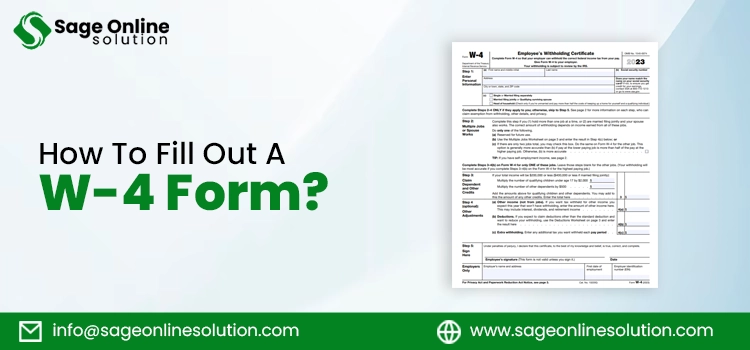
If you’re looking for how to fill out the w4 form, you need to pay more attention than in previous years after the new amendments of the One Big Beautiful Bill Act (OBBBA). As mentioned above, the form has expanded to 5 pages, adding new sections specifically to help filers keep more of their money on earning tips and overtime.
Below are the prompts to help you learn how to fill out a W-4 form. You can also call our experts at +1-844-341-4437 for expert supervision.
◦ Option A: Complete it using the IRS Withholding estimator to maintain the accuracy.
◦ Option B: Here, use the Multiple Jobs Worksheet on page 3.
◦ Option C: Ensure checking the box if there are only two jobs, paying similar. You need to do this on both the W-4 2026 form.
◦ Line 3(a): Here, you need to multiply the number of qualifying children, who are under 17, by $2,200.
◦ Line 3(b): Now, carefully multiply the total number of other dependents by $500.
◦ Now, in the Total section, add the results and enter the sum on Line 3.
◦ 4(a) section for other income.
◦ 4(b) for deductions, including Qualified tips, overtime, new car loan interest, and seniors’ deductions.
◦ 4(c) for extra withholding.
If you’re still confused or have more queries on how to fill out the W-4 form, call +1-844-341-4437, and learn from our experts. We’re a team with the updated knowledge and expertise, and can assist you 24/7.
For a single person, having no children, and only one source of income, it’s instructed to fill out Step 1 and Step 5 of the US W4 form 2026. The middle steps from 2-4 are generally left blank. Here’s the complete procedure:
Step 1: Enter Your Personal Details
Note: After this, you will be asked to claim dependent credits. Leave this section if you do not have qualifying children or dependents.
Step 2: Fill Other Adjustments
If you’re a single person with a straightforward paycheck, leave this section blank only. But:
Step 3: Finally, Sign It With A Date
Now that you are at the finish line of the ” How do you fill out a W-4 form for a single person process, simply add your signature and the respective date to finalize your withholding settings. Otherwise, the form won’t be valid. While submitting it electronically, ensure that you put your digital signature.
Recently, the W-4 form underwent major changes, altering its fundamental structure. Continue reading this section to learn what happened on which date:
The One Big Beautiful Bill Act – January 1, 2026
One of the latest and major changes that happened in 2026 is the Big Bill update. Now, the IRS has released a new 5-page W4 form following the passage of the One Big Beautiful Bill Act in late 2025. The form has expanded from 4-5 pages, specifying a full-page deductions worksheet.
Removal Of Withholding Allowances – January 1, 2020
Employees, employers, and all the filers also search for why and when the W4 form changed in 2020. Before 2026, the removal of withholding allowances was the last major change that happened on January 1, 2020. The IRS has removed the whole concept of Withholding Allowances, and as a result, the form was moved to a data-driven system.
This major adjustment to the federal form W-4 in 2020 has made withholding more accurate, but complex as well, while filing the form.
Under the latest 2026 IRS regulations and the One Big Beautiful Bill Act (OBBBA), the timing for when you get or must file a W-4 form is strictly governed by your employment status and specific annual deadlines.
1. Upon Starting A New Job (Mandatory)
When you are employed, your employer is lawfully required to provide you with a Form W-4. Now, it must be the updated 5-page 2026 version during your onboarding process. You must complete and return this form before you receive your first paycheck. If you fail to do so, your employer is mandated by the IRS to withhold taxes at the highest rate, “Single with no adjustments,” until a valid form is submitted.
2. Every Year By February 17 (For Exempt Filers)
If you are one of the few taxpayers who claim “Exempt” from federal withholding (meaning you have zero tax liability), your status does not carry over automatically.
3. When Any Event Happens (Recommended Within 10 Days)
The IRS suggests you “get” and fill out a new W-4 whenever a significant life event occurs that changes your tax liability. While not always mandatory, doing this within 10 days of the change prevents a massive tax bill or a penalty later. These events include:
If you’re still having queries regarding the Form W-4, don’t worry! We can help you professionally. Call us and learn everything regarding the 2026 form W-4. Our Team of experts is there to assist and guide you 24/7.
While the federal W-4 handles your national income tax, the CT W4 form (officially the Employee’s Withholding Certificate) is the specific state-level version for Connecticut.
Just like the federal form, it tells your employer how much Connecticut state income tax to withhold from your paychecks. However, since Connecticut uses a different tax structure than the IRS, the forms operate very differently.
1. Withholding Codes (The Letter System)
The federal form uses dollar amounts for credits, but the CT-W4 uses Withholding Codes, and they are usually A, B, C, D, or F letters.
2. The “Reduced Withholding” Calculation
Connecticut has its own set of personal exemptions that phase out as you earn more money. The CT-W4 includes a table that helps you determine if you qualify for a reduced withholding amount based on your expected annual gross income.
3. Connecticut-Specific Credits
The CT W4 form allows you to adjust for state-specific benefits that the federal form doesn’t, such as:
4. Non-Wage Income
The federal W 4 form 2025 or 2026 and the CT-W4 take two different approaches when it comes to income that doesn’t show up on the paychecks. This could be interest, dividends, or any secondary income source.
Officially known as the Oregon Employee’s Withholding Allowance Certificate, the Oregon W4 form is of this type. Many states allow employees to use the federal W-4 for state taxes, but Oregon has its own OR-W-4 form specifically to calculate taxes. Oregon’s calculation is different from that of the IRS tax match.
Let’s discuss the key differences between these two W4 form types for better insights:
This one is based on a step system and dollar amounts, which are credits and deductions, and has zero allowances.
This one is based on the allowance system, and an individual can claim allowances, which usually include 0.1, 0,1, or 2 to determine the state withholding.
Note: If one doesn’t know how to fill out a W-4 form for Oregon, call at +1-844-341-4437 for instant help. It’s because, if you don’t fill out this OR-W-4, Oregon law obliges your employer to withhold at a default rate. This rate is significantly higher than necessary.
New Jersey Tax Withholding Certificate – Instructions And Checklist
Unlike the IRS federal forms, the NJ w4 form is a mandatory state-specific document. This one is specifically for New Jersey employers to calculate the accurate amount of New Jersey Gross Income Tax to withhold from their employees’ wages.
While the Federal Form W-4 is now a system based on dollar amounts and credits, the 2026 NJ Form W4 remains operating on an allowance-based system. It’s specifically evaluated to New Jersey’s progressive tax rates and unique state credits.
2026 Main Highlights
Carefully pay attention to the NJ Form W4 instructions below to precisely determine state income tax withholding, avoid under- or over-payment penalties, and large tax bills:
This part of the form is quite critical. Here, you can select any letter from A, B, C, D, or E, as per your filing status and income.
◦ Rate Table A is for single filers or married filing separately.
◦ Rate Table B is for married joint or head of household, where only one person has a job.
◦ The C, D, and E are the dual Rate Tables, withholding at a higher rate to prevent two working spouses from possessing a large amount in April.
Here, each allowance reduces the taxable income by $1,000.
◦ 1 allowance for yourself.
◦ 1 allowance for every dependent.
◦ 1 allowance for a spouse/civil union partner.
◦ Bonus allowances for getting extra for those who are aged 65+ or are blind.
This is where you specify any dollar amount or credit that you want your employer to take out of the paycheck, along with the standard state tax calculated from allowances and the Rate Table.
◦ If you do multiple jobs, have a working spouse, or have a second source of income, the Standard Rate Tables do not withhold enough.
◦ On entering a flat dollar amount bi-weekly, this will result in extra being paid toward the New Jersey state taxes throughout the year.
Line 6 is where you can write Exempt when you meet the state’s strict income criteria. By this, no state income tax will be deducted from your pay.
2026 Key Update: Your total anticipated income for the entire year must be at or below the thresholds given below:
Any NJ 2026 Payroll Deductions?
Payroll deductions have been updated for 2026. You are now subject to automatic state payroll deductions upon completing the NJ W-4 Form. Take a look at the table below:
|
Deduction Type |
2026 Rate |
2026 Wage Base |
|
Unemployment (UI) |
0.3825% |
First $44,800 |
|
Disability (TDI) |
0.19% |
First $171,100 |
|
Family Leave (FLI) |
0.23% |
First $171,100 |
Basically, the Wage Chart is the logic center, which is available on Page 2 of the form, designed to increase your wages’ withholdings. It mainly fixes the dual-income trap when both spouses are working, or where a person has two jobs. Such employees end up in a higher tax bracket compared to their individual withholdings.
No doubt, New Jersey uses a progressive tax system, and if both spouses work, and the couple chooses the standard married rate (Rate Table B), the respective employer will withhold as the household has only a single source of income. As a result, there is a huge tax bill in April.
The Wage chart on Form NJ-W4 is not intended to provide withholding, wages, or other income. This chart tells you which Rate Table (A, B, C, D, or E) must be entered on Line 3 of the form. Selecting the right table ensures enough tax is taken out throughout the year.
When completing the W-4 form 2026 printable, it is highly recommended to read the Wage chart for specific taxpayers to ensure accurate withholding. This chart compares and cross-references the higher-paying job with the lower-paying one.
◦ Rate Table C: This table is for moderate-income dual errors, which is typically a combined income between $50,000 and $150,000.
◦ Rate Table D: It considers the high-income dual earners. This income is usually a combination of $150,000 and $40,000.
◦ Rate Table E: This one is the highest withholding rate, and is used for households if the combined income exceeds $400,000. Also, this table is considered when one spouse is primarily earning more than the other.
Looking for an easy way to learn how to fill W4 form? The IRS Tax Withholding Estimator has moved from being optional to being the most accurate way to fill out your W-4. It replaces the manual worksheets on pages 2–4 of the PDF with a simple, interview-style interface.
Let’s check how it can be helpful:
1. Accuracy For The 2026 “OBBBA” Changes
The 2026 tax year introduced new deductions that are difficult to calculate manually. The Estimator automatically helps with:
2. Solving The “Two-Job” Privacy Issue
If you use the manual “Multiple Jobs Worksheet” on the W4 2026 form, your employer might be able to guess your total household income. The Estimator eliminates such guesswork by automatically calculating one Extra Withholding amount for Step 4(c). It keeps your private financial details, such as a spouse’s high salary or a second source of income, hidden from your employer while ensuring you aren’t under-taxed.
3. The “Refund Slider” (Targeted Results)
One of the best features of the IRS Tax Withholding Estimator is the customized refund slider.
When you input your data, the Estimator automatically displays your projected 2027 refund. Let’s say, you can move the slider to say, “I want a $0 refund and more money in my weekly check,” or “I want a $2,000 refund for a vacation.” By this, the tool gives you the exact numbers to type into your W4 tax form to reach that goal.
The Notice 1392, supplement form W-4, provides the mandatory changes a non-resident alien must follow when completing the federal Form W-4. Non-resident aliens generally cannot claim the standard deduction and are restricted in their filing status, which means the standard W-4 Steps would result in incorrect tax math without these supplemental rules.
2026 OBBBA W-4 Instructions
Under the One Big Beautiful Bill Act, the 2026 Form W-4 has transformed. You must adjust the Notice 1392 rules to the new form layout. For this, have a look at the key instructions below:
Personal Information
Multiple Jobs
Claim Dependent Credits
Other Adjustments
The 2026 W4 tax form is not just a routine update. But, it shows a significant transformation in how the IRS coordinates your monthly take-home pay with your year-end tax liability. With the latest updates of OBBBA, the 2026 W4 form now introduces new and powerful additions, including the dedicated deductions for overtime compensation and qualified tips. Using and completing this form correctly can significantly boost your immediate cash flow. If you need any assistance or further information on the W4 form 2026, feel free to contact us at +1-844-341-4437.
Read Here:
Frequently Asked Questions
The W4 Tax form is an IRS document that an employee working in the US must complete for the employer to determine the exact amount that should be withheld from the paycheck. This form is then sent to the IRS by the employer only.
No, there is a significant difference between W2 and W4. The W4 form 2026 is completed by the employees to determine how much should be withheld as federal income tax from the paycheck. However, the W2 form is issued by employers annually, reporting the taxes withheld for tax filing and wages.
Yes, claiming 0 allowances on your W4 tax form ensures the maximum amount of taxes is withheld from an employee’s paycheck. Also, it helps employees get more refunds during tax time.
To fill out a W4, you need to complete Step 1 with your personal details. Also, make sure to fill in the Single or Married Filing Separately status. If you’re non-resident aliens, write NRA below Step 4(c). Use Step 3 for the $2,200 Child Tax Credit and Step 4(b) for the new 2026 OBBBA deductions, such as qualified tips and overtime. Finally, sign and mention the date on the form before submitting it to your employer to avoid the default high-withholding Single rate. To learn how to fill out the W 4 form correctly, you can call us at +1-844-341-4437.
If you do not fill out the 2026 Form W-4 when starting a job, the IRS requires your employer to withhold federal income tax as if you are single with no adjustments.

Mar 24, 2026
Mar 23, 2026
Mar 19, 2026
Mar 13, 2026
Mar 13, 2026
© Copyright 2026 Sage Online Solution | All Rights Reserved
US
UK